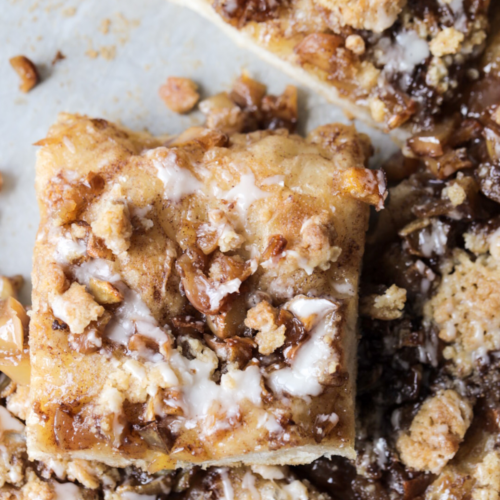
Sourdough Apple Streusel Focaccia
This sourdough apple streusel focaccia combines soft, fluffy sourdough with layers of tender cinnamon-spiced apples, a buttery brown sugar streusel topping, and a drizzle of sweet vanilla glaze. Naturally fermented and baked to golden perfection, it features a light, airy interior with crisp, caramelized edges. This delicious fall-inspired treat is perfect for breakfast, brunch, or dessert!
Print
Pin
Servings: 15 servings
Ingredients
For the Focaccia Dough
- 125 g active sourdough starter ½ cup
- 400 g warm water 1⅔ cups
- 20 g extra virgin olive oil 1½ tablespoons
- 500 g bread flour 4 cups
- 10 g salt 1½ teaspoons
For Preparing the Pan
- 56 g salted butter melted (4 tablespoons)
For the Cinnamon Apple Filling
- 227 g salted butter 1 cup
- 220 g brown sugar 1 cup, packed
- 16 g ground cinnamon 2 tablespoons
- 1 g ground ginger ½ teaspoon
- 5 g vanilla extract 1 teaspoon
- 5 medium apples diced and divided (reserve 1 diced apple for topping)
For the Brown Sugar Streusel
- 63 g all-purpose flour ½ cup
- 55 g brown sugar ¼ cup, packed
- 57 g salted butter melted (¼ cup)
For the Vanilla Glaze
- 60 g powdered sugar ½ cup
- 2 g vanilla extract ½ teaspoon
- 15 g milk 1 tablespoon, plus more as needed
Instructions
Prepare the Focaccia Dough
- Mix the dough. In a large mixing bowl, combine the active sourdough starter, warm water, and olive oil. Stir until the starter is mostly dissolved. Add the bread flour and salt, mixing until all the flour is incorporated and no dry patches remain. The dough will be very wet, sticky, and shaggy. Do not add additional flour, as the high hydration is essential for creating a light and airy focaccia. Cover and allow the dough to rest for 20–30 minutes.
- Perform the first set of stretch and folds. With damp hands, grab one side of the dough, gently stretch it upward, and fold it toward the center. Rotate the bowl and repeat until you have completed 4–6 folds. Alternatively, perform coil folds by lifting the dough from the center and allowing the ends to fold underneath. Cover the bowl and allow the dough to rest for 30 minutes.
- Perform the second set of stretch and folds. Repeat another set of 4–6 stretch and folds or coil folds. The dough should begin to feel smoother and more elastic. If time allows, rest the dough for another 30 minutes and perform a third set of folds to further strengthen the gluten and improve the focaccia's structure.
- Bulk ferment the dough. Cover the bowl and allow the dough to ferment at room temperature for approximately 4–6 hours, or until it has increased in volume by roughly 50%. The dough should appear noticeably puffy, smooth, and slightly jiggly, with visible air bubbles along the sides and surface. Fermentation times will vary depending on the temperature of your kitchen and the strength of your sourdough starter.
- Cold ferment overnight. Once bulk fermentation is complete, cover the bowl tightly with plastic wrap or an airtight lid and refrigerate overnight or for up to 24 hours. This optional cold fermentation develops flavor and makes the dough easier to handle when adding the apple filling. For a same-day bake, skip refrigeration and proceed directly to preparing the filling.
Prepare the Apple Filling and Streusel
- Prepare the cinnamon apple filling. Core and dice all five apples into small, evenly sized pieces, reserving one diced apple for topping. I do not peel my apples, but feel free to do so if you prefer! In a large skillet over medium heat, melt the salted butter. Stir in the brown sugar, cinnamon, and ground ginger until combined. Add four of the diced apples and cook for 5–8 minutes, stirring occasionally, until the apples begin to soften and release their juices and the mixture becomes thick and syrupy. The apples should still hold their shape, as they will continue cooking in the oven. Remove from the heat, stir in the vanilla extract, and allow the filling to cool for 10–15 minutes before assembling.
- Prepare the brown sugar streusel. In a small mixing bowl, melt the butter, then add the all-purpose flour and brown sugar. Use your fingertips or a fork to work the ingredients until a crumbly mixture forms with pea-sized pieces of butter throughout. Refrigerate the streusel until ready to use.
Assemble the Focaccia
- Prepare the baking pan. Pour the melted butter evenly across the bottom of a standard 13 × 18-inch half-sheet pan, spreading it into the corners and along the edges. Alternatively, you can drizzle a couple of tablespoons of extra virgin olive oil instead.Gently transfer the sourdough dough onto the buttered pan, taking care not to deflate it. Using lightly oiled hands, carefully stretch the dough into a rough rectangle. The dough does not need to fill the entire pan at this stage--it will as it ferments more during the second rise.
- Add the apple filling and fold the dough. Spoon half of the cooled cinnamon apple filling down the center of the dough, leaving a border around the edges. Working directly in the pan, fold the right side of the dough toward the center, followed by the bottom edge upward. Next, fold the left side toward the center and the top edge downward, creating a letter-style fold that encloses the filling. Starting from the bottom, gently roll or fold the dough over itself once more, flipping it so the seam is underneath and the smooth side faces upward. This creates layers of cinnamon apples throughout the focaccia.
- Allow the dough to complete its final proof. Loosely cover the pan with lightly greased plastic wrap and allow the dough to rise at room temperature for approximately 2–5 hours. During this time, the dough should relax and spread throughout most of the pan. If necessary, gently stretch it toward the corners as it relaxes. The focaccia is ready when it looks very puffy and airy, has visible bubbles throughout the surface, and jiggles slightly when the pan is gently shaken. The exact proofing time will depend on the temperature of your kitchen and whether the dough was refrigerated overnight.
Add the Toppings and Bake
- Preheat the oven and dimple the dough. Preheat the oven to 425°F (218°C). Once the focaccia is fully proofed, lightly coat your fingertips with olive oil or melted butter. Gently press your fingertips into the dough, creating deep dimples across the entire surface until your fingers nearly reach the bottom of the pan. Be careful not to tear the dough or excessively deflate the air bubbles.
- Add the remaining apple filling and streusel. Spoon the remaining cinnamon apple filling evenly over the dimpled dough, allowing some of the buttery cinnamon syrup to settle into the dimples. Try to avoid letting it spill onto the pan, as this can make the sauce burn (though I still seem to always spill some and it turns out fine, if I'm being honest! But try to avoid it. ;)). Scatter the reserved diced apple over the surface, then sprinkle the streusel you set aside earlier evenly over the top.
- Bake the focaccia. Place the pan on the center rack of the preheated oven and bake for 30–35 minutes, or until the focaccia is deeply golden brown, the edges are crisp and buttery, and the streusel is lightly caramelized. The center of the bread should be fully baked, with an internal temperature of approximately 200–205°F (93–96°C) when measured in a section of bread away from the apple filling. If the streusel begins browning too quickly, loosely tent the focaccia with aluminum foil during the final 10 minutes of baking.
Prepare the Glaze and Serve
- Make the vanilla glaze. While the focaccia cools, whisk together the powdered sugar, vanilla extract, and milk in a small bowl until smooth. Add additional milk, a few drops at a time, until the glaze reaches your desired consistency. It should be thick enough to cling to the focaccia but thin enough to drizzle easily.
- Cool, glaze, and serve. Remove the focaccia from the oven and allow it to cool in the pan for approximately 15–20 minutes. Drizzle the vanilla glaze evenly over the slightly cooled focaccia. Slice into squares or rectangles and serve warm or at room temperature.
Nutrition
Serving: 1serving | Calories: 412kcal | Carbohydrates: 60g | Protein: 5g | Fat: 17g | Saturated Fat: 10g | Polyunsaturated Fat: 1g | Monounsaturated Fat: 5g | Trans Fat: 1g | Cholesterol: 41mg | Sodium: 388mg | Potassium: 139mg | Fiber: 3g | Sugar: 28g | Vitamin A: 510IU | Vitamin C: 3mg | Calcium: 42mg | Iron: 1mg
Calories: 412kcal
Tried this recipe?Mention @Bake.With.Jamie