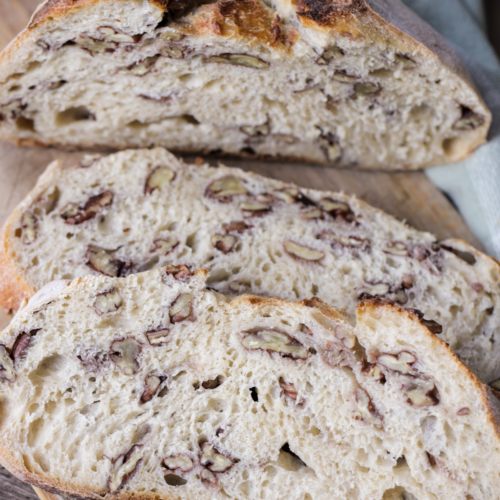
Sourdough Maple Pecan Bread
This sourdough maple pecan bread is a soft, flavorful homemade loaf made with active sourdough starter, pure maple syrup, and plenty of crunchy pecans. With a lightly sweet maple flavor, tender crumb, and golden crust, this easy sourdough bread is perfect for breakfast, brunch, or an afternoon snack.
Print
Pin
Servings: 10 slices
Ingredients
- 125 g active sourdough starter ½ cup
- 300 g lukewarm water 1 ¼ cups
- 120 g pure maple syrup ⅓ cup + 1 tablespoon
- 525 g bread flour 4 ¼ cups
- 10 g salt 1 ¾ teaspoons
- 170 g chopped pecans about 1 ½ cups
- rice flour to sprinkle over the dough during shaping and before baking
Instructions
Mix the dough
- In a large mixing bowl, combine the 125 g active sourdough starter, 300 g lukewarm water, and 120 g maple syrup. Stir until the starter and maple syrup are mostly incorporated.
- Add the 525 g bread flour and 10 g salt, then mix until no dry flour remains. The dough will look shaggy and somewhat sticky. Let rest covered for about 30 minutes before you begin your first set of stretch and folds.
- During the first 2 hours, perform 3–4 sets of stretch and folds, about 30 minutes apart. To stretch and fold, grab one side of the dough, gently stretch it upward without tearing it, then fold it over the center. Turn the bowl and repeat on all four sides.
Bulk fermentation
- Let the dough bulk ferment at room temperature for approximately 4–6 hours.
- Don't rely solely on the clock to determine when bulk fermentation is finished. The temperature of your kitchen, starter strength, and the temperature of your dough can all affect how quickly it ferments.
- How to tell when bulk fermentation is finished
- The dough should look noticeably expanded, puffy, and aerated. Look for an increase in volume of roughly 50–75%, rather than necessarily doubling. The surface should look smoother and slightly domed with bubbles, and you should be able to see bubbles along the sides and underneath the dough. When you gently shake the bowl, the dough should have a light, airy, jiggly quality. It should also feel lighter and more elastic than it did when you first mixed it.
- If the dough still looks dense and feels heavy, give it more time. If it has become extremely loose, very bubbly, and difficult to handle, it may have gone too far.
- The temperature of your kitchen will make a big difference. A warm kitchen may bring the dough to the end of bulk fermentation closer to 4 hours, while a cooler kitchen may require closer to 6 hours or longer.
Laminate in the pecans
- Once bulk fermentation is complete, gently turn the dough out onto a lightly wet work surface. Using your fingertips, carefully stretch the dough into a large rectangle. Try to stretch it evenly without pressing out all of the air.Sprinkle half of the chopped pecans evenly over the surface of the dough. Fold one half of the dough into the center, then sprinkle half of the remaining pecans over the folded section. Fold the other half of the dough over the top, then sprinkle the remaining pecans over the surface.Starting from one of the short ends, roll the dough up from one end to the other, creating a log.
Shape the loaf
- Then shape the dough into a tight ball. Pinch the edges closed, gently tuck them, and work around the loaf until you have a rough round.
- Using a bench scraper or your hands, gently pull the dough toward you across the counter. The friction between the dough and the counter will tighten the outer surface and create tension.
- Rotate the dough and repeat this motion several times until the surface feels taut and smooth. Be gentle—you want to create surface tension without pressing all of the air out of the dough or tearing it.
- If the dough is sticking excessively, allow it to rest for a few minutes or sprinkle some rice flour over the dough.
Cold proof
- Generously flour a banneton with rice flour.
- Using your bench scraper, gently lift the shaped loaf and place it seam-side up into the floured banneton.
- Cover the banneton and place it in the refrigerator for 8–12 hours, or overnight.
Preheat the Dutch oven
- The next day, place your Dutch oven inside the oven and preheat to 450°F (232°C). Allow the Dutch oven to preheat for 30–60 minutes so it is thoroughly heated.
- Because this bread contains maple syrup, the natural sugars can cause the crust to brown more quickly than a traditional sourdough loaf.
- If you have a dark-colored Dutch oven, I recommend using parchment paper, a bread sling, dry rice, or a combination of these to help prevent the bottom of the loaf from becoming too dark. You can sprinkle a layer of uncooked rice into the bottom of the Dutch oven, place parchment or a bread sling on top, and then transfer the dough into the pot.
Score and bake
- Remove the dough from the refrigerator and turn it onto a piece of parchment paper or a bread sling.
- Score the top of the loaf with a bread lame or sharp knife.
- Carefully transfer the dough into the preheated Dutch oven. Cover with the lid and bake at 450°F (232°C) for 30 minutes.
- Remove the lid and continue baking for 15–20 minutes, or until the loaf is deeply golden brown and the internal temperature reaches approximately 205–210°F (96–99°C).
- Keep a close eye on the loaf during the uncovered portion of baking because the maple syrup can cause the crust to darken more quickly. If the crust is browning too quickly, loosely tent the loaf with foil for the remainder of the bake.
Cool completely
- Carefully remove the bread from the Dutch oven and transfer it to a wire rack.
- Allow it to cool completely before slicing, ideally for at least 2 hours. Cutting into sourdough bread while it is still hot can result in a gummy interior.
- Once completely cooled, slice and enjoy!
Nutrition
Serving: 1slice | Calories: 351kcal | Carbohydrates: 51g | Protein: 8g | Fat: 13g | Saturated Fat: 1g | Polyunsaturated Fat: 4g | Monounsaturated Fat: 7g | Sodium: 390mg | Potassium: 149mg | Fiber: 3g | Sugar: 8g | Vitamin A: 11IU | Vitamin C: 0.2mg | Calcium: 33mg | Iron: 1mg
Calories: 351kcal
Tried this recipe?Mention @Bake.With.Jamie