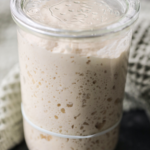
How to Make Sourdough Starter From Scratch
Yield: 1 sourdough starter
Materials
- Clear glass container--I love these Weck jars but a mason jar or even an old pasta jar works lovely!
- Digital kitchen scale
- Spoon spatula, or spurtle (these are my favorite, because they are flat and easy to wash!)
- Rubber band or dry-erase marker to track rise
- Unbleached all-purpose flour I love Farmer Direct flour, but any will do
- Rye flour optional, but highly recommended for stronger fermentation I love this organic rye flour! You can also use whole wheat flour. This will be used around days 3 or 4.
- Room temperature water non-chlorinated if possible
- Something to cover the jar with. Paper towel with a rubber band plastic wrap, a kitchen towel, a lid that isn't completely enclosing the jar. Something that will cover the jar but also keep out any fruit flies, etc.
Instructions
Sourdough Starter Basics
- Before getting started, there are a few important things to know:
- Feed your starter on a regular schedule.
- Discard half of the starter before every feeding to prevent it from becoming too large and to keep the yeast properly fed.
- Mix thoroughly after every feeding so all of the flour is hydrated and evenly incorporated.
- Scrape down the sides and bottom of the jar after stirring to prevent dry pockets of flour from developing.
- During the first few days, your starter will likely have an unpleasant smell. This is completely normal and part of the natural fermentation process.
- Once mature and ready to bake with, your starter should smell mildly sweet, slightly yeasty, and pleasantly tangy rather than sharply acidic.
Day 1: Create Your Starter
- In a clean glass jar, combine:
- 60 grams water
- 60 grams unbleached all-purpose flour
- Stir thoroughly until no dry flour remains and the mixture is smooth and thick, similar to pancake batter.
- Use a spatula to scrape down the sides and bottom of the jar so there are no dry spots hiding underneath the mixture.
- Loosely cover the jar with a lid, cloth, or coffee filter secured with a rubber band. The starter needs airflow while still being protected from drying out.
- Use a rubber band or dry-erase marker to mark the level of the starter in the jar. This makes it easy to track future growth.
- Do not expect any significant activity today or even tomorrow. Most starters do not begin rising until at least day three.
- Place the jar somewhere warm to rest at room temperature for 24 hours. If your kitchen is cool, cover the jar with a kitchen towel and place it inside an unheated microwave, turned-off oven with the light on, or another warm location.
Day 2: First Feeding
- After 24 hours, discard approximately half of the starter.
- To the remaining starter, add:
- 60 grams water
- 60 grams unbleached flour
- Mix thoroughly until smooth and scrape the sides of the jar clean.
- Today's feeding schedule is simple: feed your starter once and then allow it to rest for another 24 hours.
- You may see a few bubbles, but many starters show very little activity on day two.
Day 3: The False Rise
- Discard half of the starter once again.
- Feed with:
- 60 grams water
- 60 grams unbleached flour
- Many new sourdough bakers notice a dramatic rise in activity around day three. Your starter may suddenly double or even triple in size and become filled with bubbles.
- This stage is often referred to as the "false rise."
- The activity is caused by early bacteria that thrive during the beginning stages of fermentation rather than the stable wild yeast colony you're trying to cultivate. While it can be exciting to see so much growth, your starter is not yet ready for baking.
- Continue feeding once per day and trust the process.
Day 4: Switch to Twice Daily Feedings
- Starting on day four, begin feeding your starter every 12 hours instead of every 24 hours.
- Before each feeding:
- Discard half of the starter.
- Add 60 grams water.
- Add 60 grams flour.
- Stir thoroughly and scrape the jar clean.
- To help strengthen your starter and encourage microbial activity, you can replace 10 to 30 grams of the flour with whole rye flour during each feeding.
- Many bakers find that rye flour helps establish a stronger and more active starter more quickly, especially in cooler environments.
Days 5 Through 14: Stay Consistent
- For the next week or two, continue following the same routine every 12 hours:
- Discard half of the starter.
- Feed with 60 grams water and 60 grams flour.
- Optionally include 10 to 30 grams of rye flour to boost activity.
- Stir thoroughly after every feeding.
- Scrape down the sides and bottom of the jar each time.
- Consistency is the key to success during this stage.
- It is very common for starters to become less active after the excitement of the false rise. Many people mistakenly believe their starter has died and give up too early.
- Keep feeding it.
- Even if your starter appears quiet for several days, important microbial changes are taking place beneath the surface as the wild yeast colony develops and stabilizes.
What to Expect During the Process
- Every starter develops at its own pace, but these are some common signs of progress:
- Small bubbles appearing throughout the mixture
- Increasing amounts of rise after feedings
- A pleasant tangy aroma similar to yogurt or buttermilk
- A light and airy texture developing over time
- Remember that periods of slower activity are completely normal, especially after the false rise.
- Continue feeding consistently and avoid changing your schedule too often.
When Is Your Sourdough Starter Ready to Bake With?
- A mature starter will show several signs that it is strong enough for baking:
- It consistently doubles in size within 4 to 6 hours after feeding.
- It has an airy texture filled with bubbles throughout the jar.
- It smells pleasantly tangy and yeasty rather than sharply acidic or unpleasant.
- It rises and falls predictably after each feeding cycle.
- For most kitchens, this process takes around 14 days, although cooler temperatures can extend the timeline slightly.
- Once your starter reaches this stage, you're ready to bake your first loaf of homemade sourdough bread.