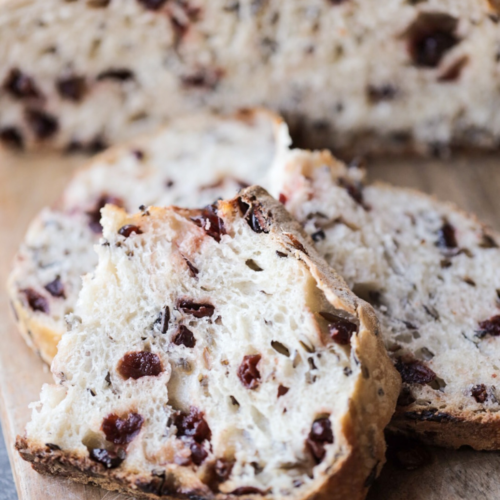
Wild Rice Cranberry Sourdough Bread
This sourdough cranberry wild rice bread pairs a crisp, golden crust with a soft, chewy crumb full of nutty wild rice and sweet-tart dried cranberries. Made with just six ingredients and an overnight cold proof, it’s a cozy loaf for your holiday table, homemade gifts and the best leftover turkey sandwiches.
Print
Pin
Servings: 12 slices
Ingredients
For the dough
- 150 grams sourdough starter active and bubbly (⅔ cup)
- 400 grams warm water 1⅔ cups
- 550 grams bread flour 4½ cups plus 1 tablespoon
- 10 grams fine salt 1¾ teaspoons
For the mix-ins
- 164 grams cooked wild rice cooled and well drained (1 cup)
- 160 grams Craisins or other sweetened dried cranberries 1 cup
For shaping and baking
- Bread flour or rice flour for the work surface and banneton (as needed)
- Rice flour for dusting the top of the loaf, optional (as needed)
- 12 to 25 grams uncooked rice or cornmeal for the Dutch oven (1 to 2 tablespoons)
Instructions
- Prepare the wild rice. Cook the wild rice according to the package directions, or use leftover cooked wild rice. About 55 grams (⅓ cup) uncooked rice makes roughly 164 grams (1 cup) cooked. Drain it very well, spread it out to cool completely, and pat away any surface moisture. This can be done up to a day ahead; keep the rice covered in the refrigerator and let it come to room temperature before using.
- Feed your starter. Feed your starter 4 to 6 hours before you plan to mix the dough. It is ready when it has roughly doubled in size and is full of bubbles.
- Mix the dough and rest. In a large mixing bowl, combine 150 grams active starter, 400 grams warm water and 550 grams bread flour. Mix with a dough whisk or your hands until no dry flour remains. The dough will look shaggy, which is perfectly normal. Cover the bowl with plastic wrap or a clean kitchen towel and let it rest in a warm spot for 30 minutes.
- Add the salt and do the first stretch and fold. Sprinkle 10 grams salt evenly over the dough and use your fingers to press it in. Lift one side of the dough, stretch it upward and fold it over the center. Rotate the bowl 90 degrees and repeat until you have completed 4 folds, working your way around the bowl. Cover the dough and place it in a warm spot. Bulk fermentation begins now and will last 4 to 6 hours.
- Add the wild rice and cranberries during the second stretch and fold. After 30 to 45 minutes, uncover the dough and wet your hands to prevent sticking. Scatter about half of the wild rice and half of the cranberries over the surface and press them in gently. Stretch one side of the dough up and fold it over the mix-ins, rotate the bowl 90 degrees, and repeat once more so the first half is enclosed. Scatter the remaining rice and cranberries over the top, press them in, and complete the last 2 folds, tucking in any pieces that escape. The dough will feel lumpy and slippery and may tear slightly, and the mix-ins will look uneven. That is normal. They will distribute and the dough will smooth out over the next few sets.
- Finish bulk fermentation. Cover the dough and repeat the stretch and folds every 30 to 45 minutes for the remainder of the 4 to 6 hours. Toward the end of bulk fermentation, switch to gentler coil folds: slide both hands under the middle of the dough, lift it so it stretches, and let the ends tuck underneath. Rotate the bowl 90 degrees and repeat 3 more times. The dough is ready to shape when it has increased in size by 50 to 100%, looks airy, and jiggles when you move the bowl.
- Shape the dough. Scrape the dough onto a clean, lightly floured surface and gently stretch it into a rectangle about 8 by 15 inches (20 by 38 cm). Stretch each corner out and fold it into the center. Roll the dough up like a burrito, then fold the short sides underneath. To build tension, use both hands to push the dough away from you and coax it back several times, shaping it into a tight ball. Tuck any cranberries on the surface under the dough, since exposed fruit can scorch in the oven. Flour the banneton well and use a scraper or your hands to place the dough in it, top side down.
- Cold proof. Cover the banneton and refrigerate for 12 to 24 hours.
- Preheat the oven. Place your Dutch oven in the oven and preheat to 450°F (232°C) for 30 to 60 minutes.
- Turn out and score. Lightly flour a sheet of parchment paper. Take the dough straight from the refrigerator and turn the banneton upside down onto the parchment to release it. Dust the top with rice flour, if desired. Using a lame or sharp knife, make one deep slash down the center, adding light leaf patterns if you like. Scoring gives the loaf a place to expand and creates a crust with crisp edges around each cut.
- Bake covered. Carefully remove the hot Dutch oven and sprinkle 12 to 25 grams (1 to 2 tablespoons) uncooked rice or cornmeal over the bottom. Lower the dough in using the parchment. Cover and bake at 450°F (232°C) for 30 minutes.
- Bake uncovered. Remove the lid and bake for 20 minutes more, or until the crust is deeply golden and the center of the loaf reaches 205°F (96°C) on an instant-read thermometer. If it is not there yet, continue baking and check every few minutes.
- Cool. Transfer the loaf to a wire rack and let it cool for 30 to 60 minutes before slicing. The crumb continues to set as it cools, so a full hour gives the cleanest slices.
Notes
Notes:
- Weigh your ingredients. The grams are the most accurate measurement for this recipe. Cup measurements are approximate.
- Keep the rice dry and cool. Warm or wet rice adds extra moisture and can make the dough harder to handle.
- This is a big loaf. With the mix-ins, the dough weighs about 1.4 kg (a little over 3 pounds), so choose a banneton and Dutch oven with plenty of room.
- Watch the crust. The sugar in the cranberries encourages browning. If the crust is getting too dark before the loaf reaches 205°F (96°C), tent it loosely with foil.
- Storage. Keep the cooled loaf in an airtight container or bread bag at room temperature for up to 3 days, or freeze slices for up to 3 months. Toast straight from the freezer.
Nutrition
Serving: 1slice | Calories: 232kcal | Carbohydrates: 50g | Protein: 6g | Fat: 1g | Saturated Fat: 0.1g | Polyunsaturated Fat: 0.4g | Monounsaturated Fat: 0.1g | Sodium: 327mg | Potassium: 66mg | Fiber: 2g | Sugar: 10g | Vitamin A: 1IU | Vitamin C: 0.03mg | Calcium: 10mg | Iron: 1mg
Calories: 232kcal
Tried this recipe?Mention @Bake.With.Jamie